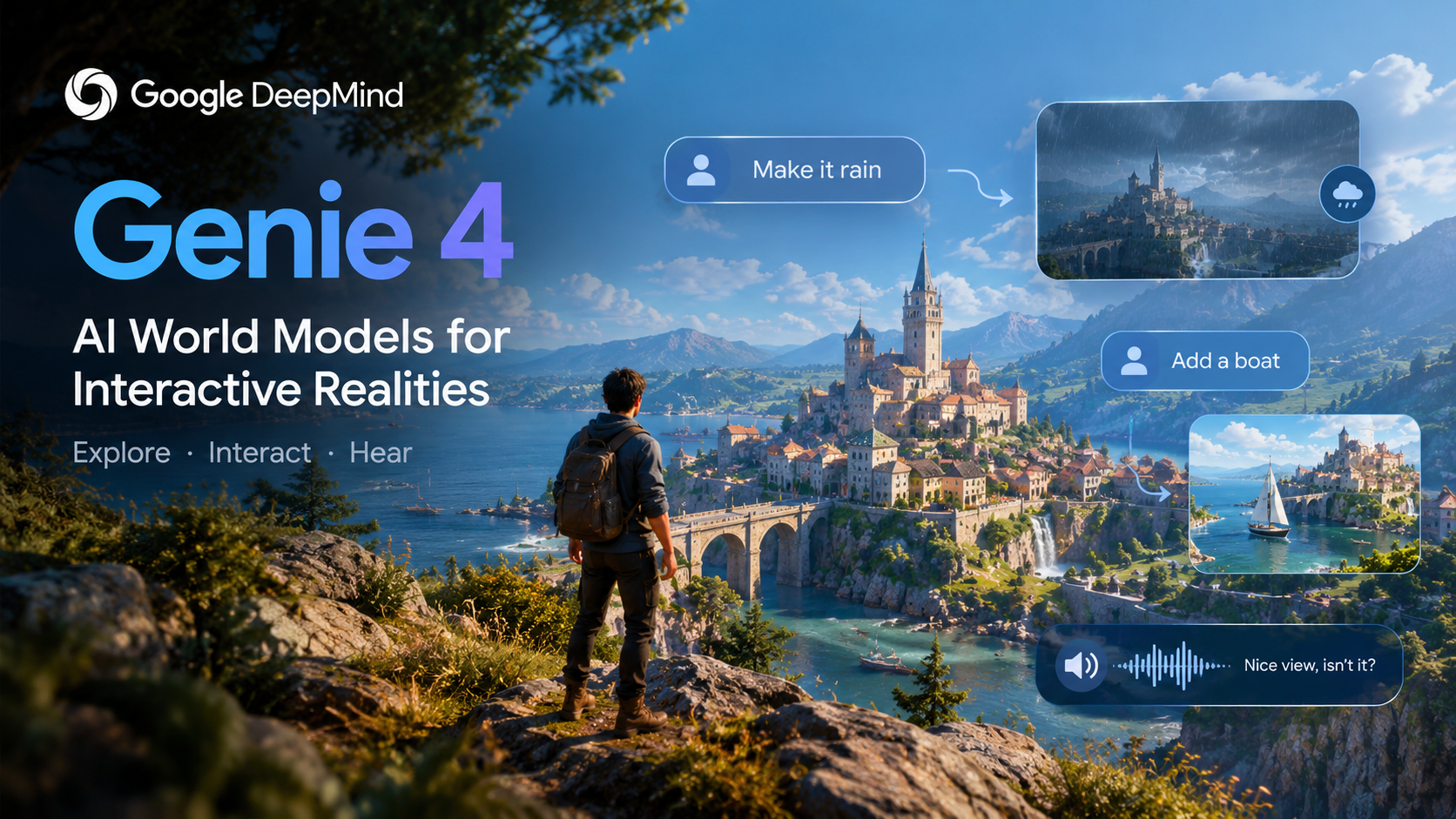
Google DeepMind has unveiled Genie 4, a new AI world model that generates interactive environments with dynamic visuals, natural-language controls, and built-in audio. The technology could help developers prototype games, visualize film scenes, and create virtual training environments for robots and AI agents.
Google DeepMind announced Genie 4 on October 27, 2026, introducing a new step in its research into AI-generated interactive worlds. Unlike conventional image and video generation tools, which primarily produce visual content, Genie 4 is designed to simulate environments that users can explore and modify while they are running.
The model combines more realistic visuals, improved character movement, and native audio generation. Users can change elements of a simulated scene through natural-language prompts, allowing the environment to respond without requiring them to restart the entire experience.
Genie 4 is currently available as a research preview for a limited group of trusted testers. Google plans to expand access through Project Genie, the Gemini API, and Google AI Studio.

What Is Google Genie 4?
Genie 4 is an AI world model developed by Google DeepMind to generate and simulate interactive environments in real time.
A world model aims to represent how an environment behaves and changes in response to actions. Rather than generating a single image or a predetermined video sequence, Genie 4 creates an environment that users can navigate and influence as the simulation progresses.
For example, a user could describe a forest, a city street, or a fictional landscape and then explore the generated scene. They can also issue new instructions to change the weather, adjust the camera, or introduce additional objects and characters.
The model then attempts to adapt the environment to the new instructions while maintaining continuity with the existing scene.
Google says Genie 4 builds on earlier work in interactive world generation, with improvements in visual realism, movement, and the ability to respond to ongoing user input.
Real-Time World Editing Through Natural Language
One of Genie 4’s central features is the ability to modify an environment while it is being simulated.
Instead of rebuilding a scene from scratch whenever a requirement changes, users can describe adjustments in ordinary language.
Examples include:
- Changing sunny weather to fog or rain.
- Moving the camera to explore a different part of the environment.
- Introducing a new object or character into an existing scene.
- Adjusting elements of a scene as an interactive experience develops.
The model attempts to interpret each instruction in context and adapt the simulation accordingly.
This approach could make interactive world generation useful during early creative development. A game designer, for example, could experiment with a visual concept or environmental change before investing time in a complete game-engine implementation.
However, the ability to modify a scene in real time does not mean every instruction will produce a perfectly consistent result. Google identifies long-term scene consistency and complex interactions as ongoing areas of research.
Genie 4 Adds Native Audio and Interactive Dialogue
Genie 4 also introduces audio generation as part of its interactive simulation capabilities.
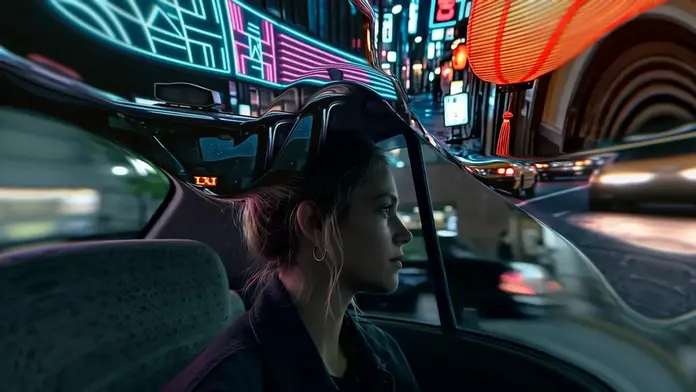
According to Google DeepMind, the model can generate environmental sounds, music, and interactive dialogue alongside the visual world. The audio is produced directly by Genie 4 rather than simply being added as a separate soundtrack after the scene has been generated.
This creates the possibility of environments that respond through both sight and sound.
A simulated outdoor scene, for example, could include ambient environmental sounds, while a scene containing characters could incorporate generated speech and movement.
Native audio could be particularly useful for game prototypes, immersive storytelling, and early-stage film visualization. Developers could evaluate the atmosphere of an environment before separately producing all of its final sound assets.
The feature remains experimental, however. Google notes that accurate real-time audio and other complex simulation behaviors still require further development.
How Genie 4 Uses Gemini Models
Genie 4 incorporates capabilities from Google’s Gemini model family to help coordinate and maintain its simulations.
Google DeepMind explains that Gemini Omni helps ground generated environments in real-world appearance and behavior, while other Gemini models provide reasoning capabilities that help maintain coherence and continuity.
The company also describes a process in which Gemini 3.8 Flash acts as a guiding agent during simulation. It breaks tasks into smaller steps, observes incoming frames, and checks whether the intended actions have succeeded.
If a user changes the scene or the environment evolves unexpectedly, the system can adjust its plan while the simulation continues.
This combination of visual generation and step-by-step reasoning is intended to make interactive environments more responsive to complex instructions.
Rather than treating every prompt as an isolated request, the system attempts to track what is happening and determine what should happen next.
Even so, this does not guarantee perfect physical accuracy or reliable outcomes across every possible interaction.
Potential Applications in Gaming, Film, and Robotics
Google sees several possible uses for Genie 4, particularly in fields that benefit from rapidly creating and modifying simulated environments.
Game Development and Interactive Prototyping
Game developers could use Genie 4 to explore level concepts, environmental designs, and interaction ideas through natural-language instructions.
Instead of immediately building a complete scene in a conventional game engine, a developer could generate an initial environment, experiment with changes, and evaluate different creative directions.
This could help with early-stage prototyping, although the generated output should not be confused with a finished, production-ready game.
Film Production and Previsualization
Filmmakers and creative teams could use interactive environments to explore camera angles, lighting conditions, scene composition, and visual concepts.
The ability to change a scene while navigating it may help teams communicate ideas before committing to more expensive production work.
Genie 4 could therefore become a useful tool for previsualization and concept development, rather than a replacement for the full filmmaking process.
Robotics and AI Agent Training
Simulated environments can provide spaces where robots and AI agents encounter different scenarios without immediately interacting with the physical world.
Genie 4 could help researchers generate varied environments and test how an agent responds to changing conditions.
Potential applications include evaluating navigation, interaction, and task-planning behavior. However, success in a generated simulation does not automatically establish that a robot or AI system will perform equally well in reality.
Environmental and Scenario Simulation
Dynamic virtual environments could also help researchers and creative teams visualize hypothetical situations, changing surroundings, and complex sequences of events.
The usefulness of these simulations will depend on their reliability, the accuracy of their underlying assumptions, and the extent to which their behavior can be validated.
Genie 4 Still Has Important Limitations
Despite its improvements, Genie 4 remains an early-stage research technology.
Google DeepMind acknowledges that visual details and object permanence can drift as a simulation continues. An object may change or fail to remain consistent, particularly during longer sessions, repeated complex edits, or movement through different parts of an environment.
Other challenges include accurately simulating complex physical interactions, maintaining spatial consistency, generating precise real-time audio, and rendering readable text.
These limitations matter because interactive simulations require more than convincing individual frames. Objects, characters, and environmental conditions must remain sufficiently consistent as users move around and introduce new instructions.
For applications such as robotics research, developers will also need to assess whether a simulated scenario accurately represents the conditions they intend to study.
Genie 4 should therefore be viewed as an experimental platform for interactive simulation, not a fully reliable replacement for established simulation systems or production tools.
Genie 4 Availability and Early Access
Google DeepMind has begun distributing Genie 4 as a research preview to a limited group of trusted testers.
The company plans to expand access through the following channels:
- Project Genie: An interactive experience for users who want to create and explore AI-generated worlds.
- Gemini API: An early-access route for developers interested in integrating the technology into their workflows.
- Google AI Studio: Another planned access point for eligible developers and early-access partners.
Google has not announced a general release date or published pricing for Genie 4 access through the Gemini API and AI Studio.
The company says access through Project Genie will begin with Google AI Ultra subscribers, while broader availability will depend on the rollout. Interested users can check Google DeepMind’s official announcement for the latest access information.
What Genie 4 Means for AI-Generated Worlds
Genie 4 highlights a shift in generative AI from producing individual media assets toward creating environments that users can actively explore and influence.
Its combination of real-time scene editing, reasoning support, and native audio could make it easier for developers and creative teams to experiment with interactive ideas before building complete applications.
The technology also illustrates the challenges involved in making AI-generated environments remain coherent over time. Realistic visuals alone are not enough when objects, characters, sound, and physical interactions must respond consistently to user actions.
For now, Genie 4 remains a research preview. Its practical value will become clearer as more developers and researchers gain access and test how well it performs in real workflows.
Image Credits: Images used in this article are sourced from official Google DeepMind materials. All rights to the original images belong to their respective owners.
Official source:Google DeepMind — Genie 4: A New Generation of World Simulation